
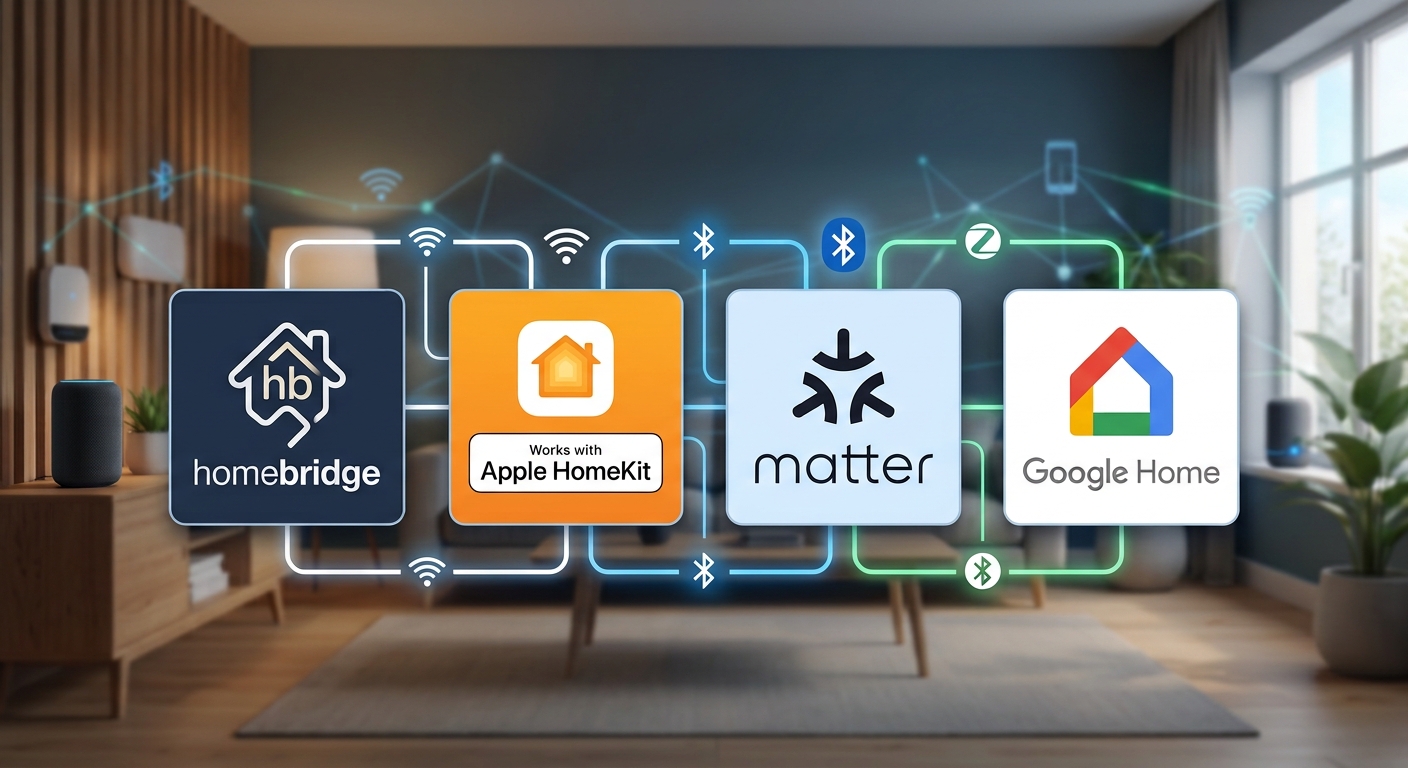
Why Homebridge Was Created
When Apple launched HomeKit in 2014 alongside iOS 8, it introduced a powerful vision: a secure, unified framework letting iPhones, iPads, and Siri control smart home accessories. The problem was adoption. HomeKit required manufacturers to implement Apple’s proprietary Home Accessory Protocol (HAP) and, in the early years, embed specific Apple-certified chips into their hardware. Most smart home brands—especially budget and mid-range ones—simply didn’t bother.
This left a huge gap between what people already owned (Wemo switches, Nest thermostats, generic Wi-Fi plugs, IP cameras) and what Siri could actually control. Developer Nick Farina stepped in, building on reverse-engineering work done by Khaos Tian in the HAP-NodeJS project, and created Homebridge: a lightweight, open-source Node.js server that emulates the HomeKit Accessory Protocol on your local network. In effect, Homebridge acts as a translator—it pretends to be a legitimate HomeKit device to Apple’s ecosystem while communicating with the real device using whatever API, cloud service, or local protocol the manufacturer actually provides .
The tagline on the project’s own GitHub page sums up the philosophy well: “HomeKit support for the impatient.” It was built for tinkerers who didn’t want to wait for official support—or who owned devices that would likely never get it .
Core Features
Homebridge is free, non-commercial, and entirely community-driven—it has no formal affiliation with Apple, Google, Amazon, or the Connectivity Standards Alliance .
- Plugin ecosystem: Over 2,000 plugins, published on NPM and tagged as homebridge-plugin, provide bridges to virtually every major smart home brand—Ring, Nest, TP-Link Kasa, Philips Hue/deCONZ, Belkin Wemo, SwitchBot, UniFi Protect, Roomba, Lutron Caseta, Tado, and many more .
- Native Siri and Apple ecosystem integration: Once bridged, accessories appear directly in the Apple Home app (or third-party apps like Eve for HomeKit) and respond to natural voice commands (“Turn off the lights downstairs,” “Set the temperature to 20 degrees”) . Automations and remote access: With a home hub (Apple TV, HomePod, or iPad), Homebridge-bridged devices support the same automations and secure remote control as native HomeKit accessories.
- Homebridge UI: A web dashboard for installing/configuring plugins, monitoring the server, managing accessories, creating isolated “child bridges” per plugin (to prevent one buggy plugin from crashing everything), and backing up/restoring the whole setup .
- Matter support (v2 and beyond): This is the big architectural shift. As of Homebridge v2, plugins can expose their devices not just via HomeKit but directly over the Matter protocol, opt-in per bridge, so the same bridged accessory becomes visible to Apple Home, Google Home, Amazon Alexa, and Samsung SmartThings simultaneously—without needing separate integrations for each .
- Broad device-type coverage: lights, switches, outlets, motion/contact/temperature/humidity/leak/smoke/air-quality sensors, locks, thermostats, fans, window coverings, robot vacuums, and water valves.
Interfaces UI – from NPM package
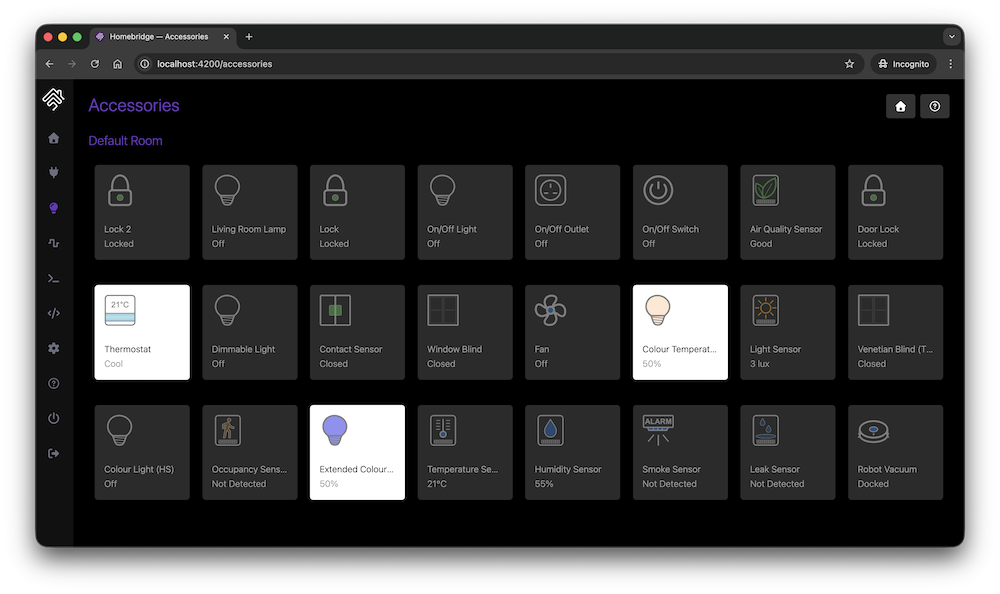
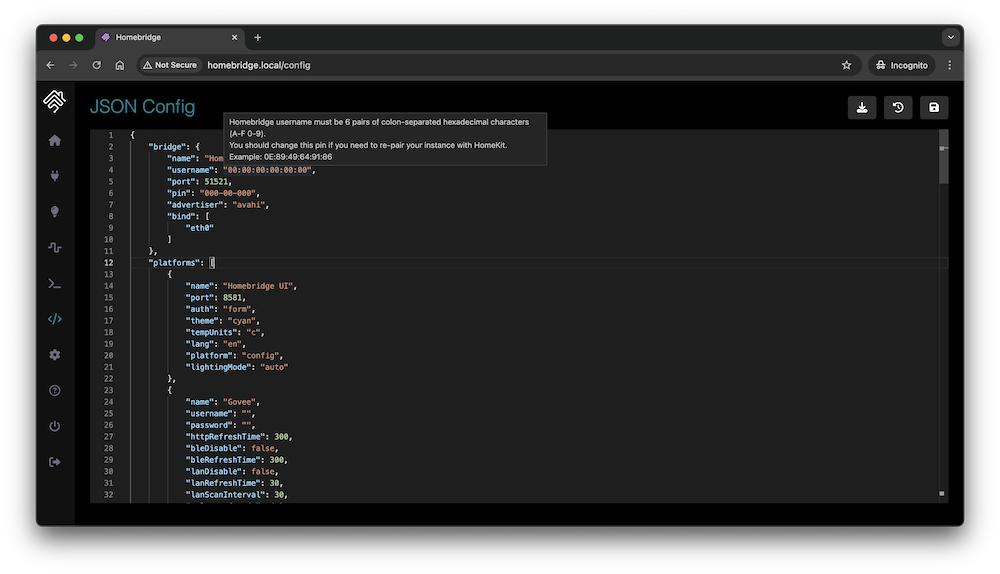
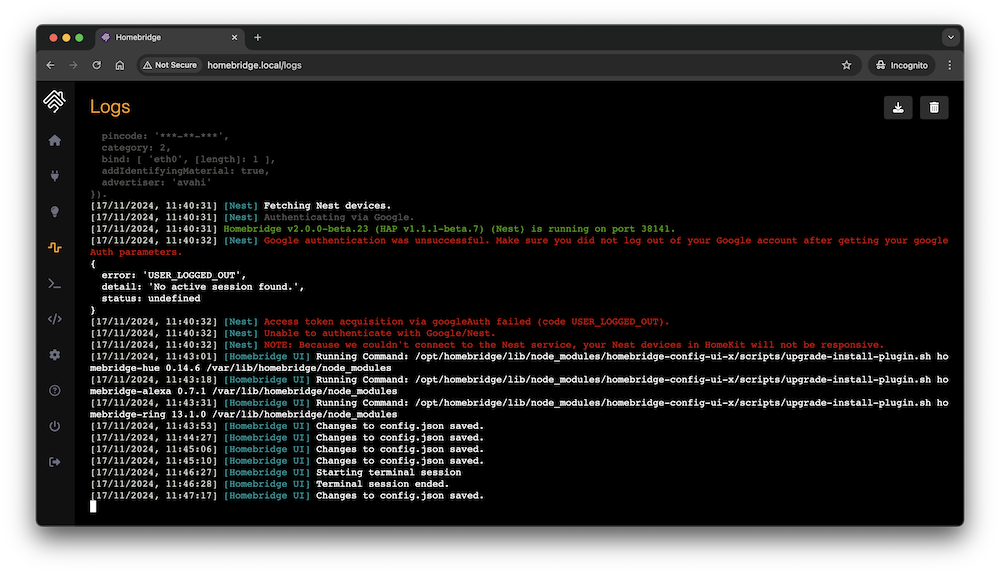
Accessories page : This shows you the Homebridge accessories for all the Homebridge instances on your network. You can use this to control accessories from a web browser and works well on mobile devices which allows users to control Homebridge from non-Apple devices.
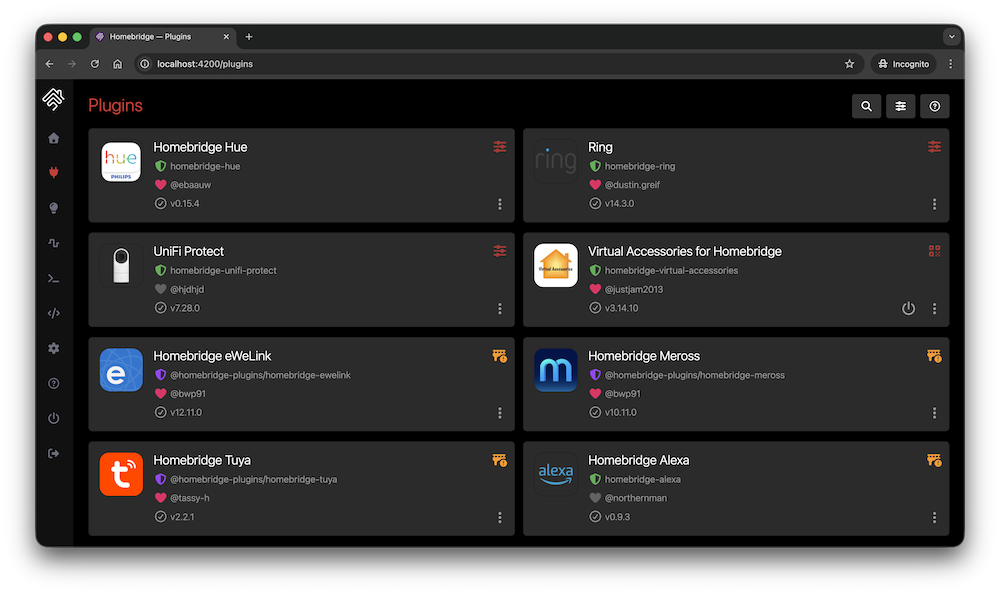
Plugings page : This shows you the currently installed plugins and allows you to install, configure, update, and remove plugins.
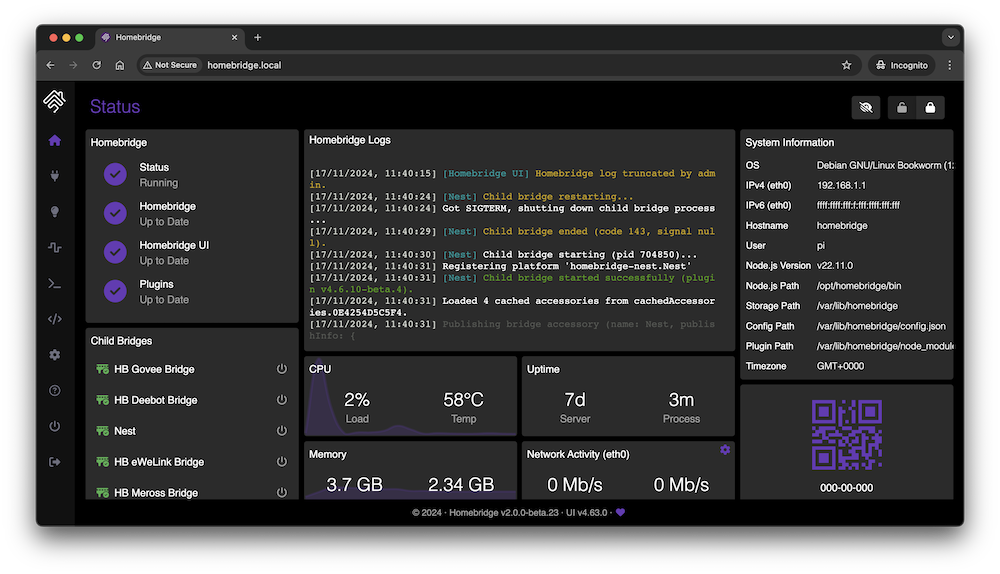
Status Screen : This shows an overview of your Homebridge system. The dashboard is widget-based and completely customisable with a number of themes available.
Configuration page : The configuration screen allows you to modify your Homebridge config.json. The built-in editor automatically syntax-checks your JSON and makes a backup of your config every time you make a change.
Log page : This shows you the Homebridge rolling log. This is helpful for troubleshooting.
Why It Matters Even More in the IoT Era
Homebridge’s relevance hasn’t faded as the smart home market matured—if anything, it has grown, for a specific reason: the industry is now consolidating around subscriptions and platform lock-in, and Homebridge is one of the few tools that pushes back against that.
The IoT boom of the last decade multiplied the number of connected devices in homes dramatically, but it also multiplied fragmentation and business-model friction:
- Apple’s shift toward subscription-flavored smart home services. Apple has increasingly tied advanced Home features to services layers (HomeKit Secure Video storage requires iCloud+, for instance), and its 2026 architecture overhaul retires the original 2014-era HomeKit framework entirely (support ends February 10, 2026) in favor of a new hub-centric architecture built around Apple TV/HomePod as always-on controllers, designed specifically to support full Matter compatibility . This is part of a broader industry trend where hardware companies increasingly monetize the software layer—cloud storage, AI features, advanced automations—as recurring revenue rather than one-time purchases.
- Matter’s rise as the “universal language.” Since Project CHIP launched in 2019 (backed by Apple, Google, Amazon, and the Zigbee Alliance), Matter has evolved rapidly: 1.0 in October 2022, expanding through 1.2 (major appliances), 1.3 and 1.4 (energy management, EV chargers, solar/heat pumps), 1.5 (cameras, closures) in late 2025, and 1.6 in June 2026 (NFC commissioning, Joint Fabric, thermostat automation suggestions) . The promise: buy any Matter-certified device and it works across ecosystems without cloud relays.
- Homebridge sits exactly at the intersection of these two trends. It lets users keep using cheap, older, or niche devices that never got official Matter or HomeKit certification, while now also exposing those same devices to Matter—meaning a $10 no-name smart plug bought years ago can, via a Homebridge plugin, become visible to Apple Home, Google Home, and Alexa all at once, sidestepping both certification costs and vendor subscription paywalls .
In short: as IoT devices multiply and big platforms increasingly try to monetize the ecosystem layer around them, Homebridge remains a grassroots equalizer—open-source glue that keeps consumer choice and interoperability alive rather than ceding it to whichever company controls the hub.
Where Homebridge Is Headed
Homebridge’s own trajectory mirrors the industry’s shift from “single-ecosystem bridging” to “protocol-agnostic bridging.” The addition of native Matter output in Homebridge v2 is the clearest signal: rather than being purely a HomeKit-compatibility tool, Homebridge is repositioning itself as a universal accessory bridge—one config, one plugin, output to any Matter-capable controller (Apple, Google, Amazon, SmartThings, Home Assistant), plus legacy HomeKit for anyone still on older setups .
Several forces will likely shape its future role:
- Matter’s maturation reduces some of Homebridge’s original purpose (new devices increasingly ship “Works with Matter” natively), but it doesn’t eliminate it. Millions of pre-Matter devices—Wemo plugs, older Hue bulbs, proprietary cameras, legacy sensors—will never receive firmware updates, and Homebridge’s 2,000+ community plugins remain the only realistic path to bring them into modern ecosystems .
- The “long tail” problem persists. Matter certification has real costs and complexity; niche, regional, or budget manufacturers will keep skipping it, just as many skipped HomeKit certification a decade ago. Homebridge’s community-plugin model is faster and cheaper to extend than any official certification pipeline, so it will likely keep being the first place support appears for oddball hardware. A more prominent role as neutral infrastructure. With Homebridge no longer tied exclusively to Apple’s ecosystem, it’s positioned to become the plugin/translation layer of choice for anyone who wants a self-hosted, privacy-respecting, subscription-free alternative to platform clouds—appealing to the same audience gravitating toward tools like Home Assistant. Risk of relevance decline for “core” categories. As lighting, locks, and thermostats standardize under Matter 1.x natively, Homebridge’s value proposition may consolidate around cameras, appliances, irrigation, and other categories where certification lags (Matter cameras only arrived in version 1.5, late 2025) .
Ultimately, Homebridge’s future isn’t about competing with Matter—it’s about being the community-run safety net underneath it: the layer that keeps old, cheap, and orphaned devices useful long after their manufacturers or original ecosystems have moved on.
Homebridge contributions
Here, you can see my latest contribution for Homebridge.. a few more will probably arrived with times.

Leave a Reply