
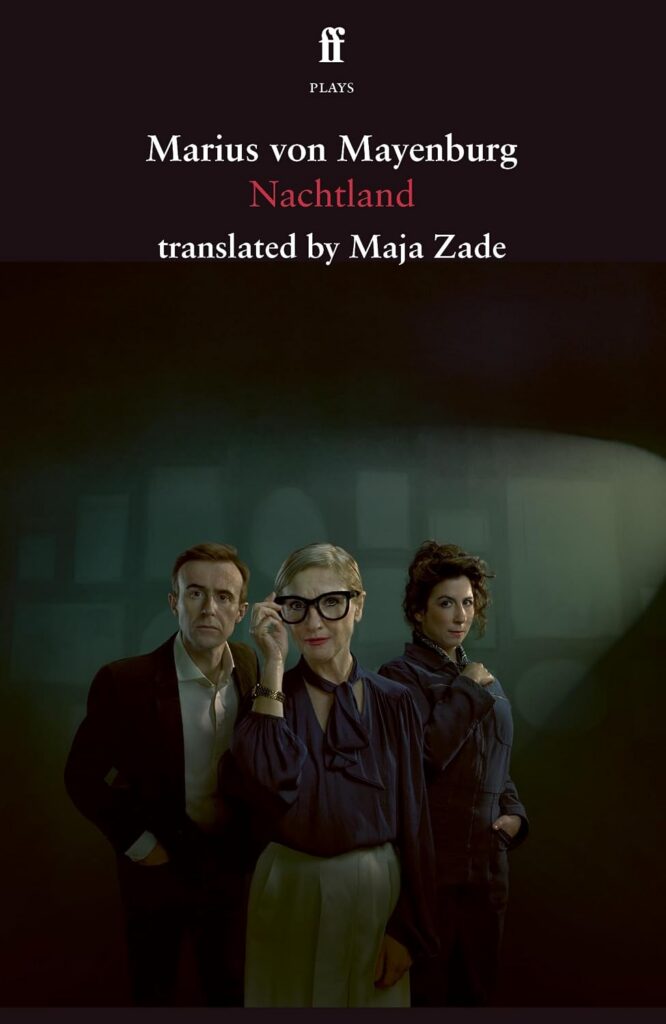
Nachtland
translated by Maja Zade
FinishedSummary
The people who buy paintings like this aren’t just driven by aesthetic desire. People who buy paintings like this want a story. A story that catapults them into the orbit of the Führer.
As Nicola and Philipp are clearing out their late father’s house, they find an old painting stashed in the attic: a quaint watercolour of a church on a pale summer day, signed ‘A. Hitler’.
Nicola wants to sell it. Philipp wants to keep it. Philipp’s wife Judith wants to burn it.
A jagged satire from one of Germany’s foremost playwrights, Nachtland opened at the Young Vic Theatre, London, in February 2024.
There's no statement without the person making the statement, there's no art without the artist.
My Review
Nachtland, by Marius von Mayenburg, is a play that deliberately embraces provocation as its dramatic engine. It exposes the worst in its characters to explore a burning question: can we truly separate the artist from their work?
Through figures that are by turns opportunistic, moralizing, or simply overwhelmed by their own contradictions, Mayenburg crafts a human gallery oscillating between the grotesque and the disturbingly plausible.
The play multiplies its angles of attack: ethical debates, vulgar provocations, and parallels so heavy-handed they sometimes verge on irrelevance. Yet despite these excesses, it manages to evoke a wide range of emotions. We laugh, we cringe, we feel outraged, but we also – sometimes reluctantly – understand the characters? reasoning, however twisted or exaggerated it may be. It is precisely in this tension between rejection and comprehension that the play finds its strength.
Reading Nachtland, it is impossible not to think of contemporary debates surrounding the separation between an artwork and its creator. The controversies involving Roman Polanski during his Oscar recognition, or the public accusations surrounding Gérard Depardieu, resonate strongly with the questions raised by the pLay. Nachtland seems to converse with these cases, not to judge them, but to reveal how deeply they divide us and expose our own moral contradictions.
On another level, the play reminded me of Le Prénom by Matthieu Delaporte, a French comedy that sparked intense discussion upon its release. Both works share a similar device: a family gathering that spirals out of control around a charged symbobvo here a painting, there a name But while Le Prénom relies on 6-humor and social discomfort, Nachtland pushes provocation much furtherluv ziotisq confronting the audience with its own ehical boundarie.
Ultimately, Nachtland is disturbing, sometimes excessive, but indeniably stimulating play. It forces us to face questions we often prefer to avoid, and or that may well be its greatest achievement.